
Is it a FIDIC Contract or Bespoke ?
Do changes made to GCs of FIDIC Contract make it a Bespoke Contract ?
QS_talks
5/18/20266 min read
A while ago one of my colleagues at the office made a bold statement that “any changes made to the GCs of a FIDIC contract turns it into a Bespoke contract and it no longer remains a FIDIC contract”.
As someone who has worked extensively with FIDIC contracts for nearly a decade, I knew that this statement could not be generalized for all changes made to the General Conditions of Contract under FIDIC. Further discussions with colleagues and friends in the construction industry revealed that this misconception is widespread among users of FIDIC contracts across many regions.
In this article, I have attempted to methodologically scrutinize this aspect of FIDIC contracts to see if any such changes turns a FIDIC contract into a Bespoke one.
The Argument
“Under FIDIC Forms of Contract, any amendment to the General Conditions of Contract by either changing the time limits or changing the durations or Addition/Omission of any word/sentence/paragraph or Addition/Omission of any sub-clause makes the Contract a Bespoke Contract & it no longer remains a FIDIC based Contract”
2. Sample Amendments
I have extracted a few such amendments made to the GCs of one of my previous projects under FIDIC EPC/Turnkey contract (Silver Book, 1999 1st Edition)
Amendment #1: Sub-Clause 4.3, GCC under EPC/Turnkey Projects (refer pg 12)
Amend by inserting the following words at the end of the Sub-Clause:
"If the Contractor's Representative, or these persons, is not fluent in English Language, the Contractor shall make a competent interpreter available during all working hours".
Amendment #2: Sub-clause 4.21, para 1, in GCC under EPC/Turnkey Projects (refer pg 16)
Delete the First Sentence in first paragraph and amend by inserting the following words at the beginning of the first paragraph of Sub-Clause:
"Monthly progress reports shall be prepared by the Contractor and submitted to the Employer in one copy".
Amendment #3: Addition of a new Sub-Clause 6.12 to the GCC under EPC/Turnkey Projects (refer pg 22)
Amend by inserting the following new Sub-Clause:
"The Contractor shall not, otherwise than in accordance with the laws of the Country, import, sell, give, barter or otherwise dispose off any alcoholic liquor or drugs, or permit or allow importation, sale, gift, barter or disposal by Contractor's Personnel."
All of the above amendments necessarily change the standard General Conditions of Contract. The argument follows that such a contract cannot be recognized as a FIDIC contract and has become a bespoke contract due to the changes introduced in the General Conditions. To verify this, we must refer to the 'guiding torch' of FIDIC contracts, known as the 'FIDIC Golden Principles'."
3. The FIDIC Golden Principles
In 2019, FIDIC published 'The FIDIC Golden Principles' as guidance for drafting FIDIC-based contracts. The very fact that such guidance exists indicates that FIDIC acknowledges that users of FIDIC forms of contract may have to make reasonable changes to suit their specific purposes. This is further evidenced below:
Page 6, Para 8-10, The FIDIC Golden Principles, 1st Edition 2019.
"It may be necessary for such PCs to amend the GCs to comply with mandatory Laws that apply to the Site or to comply with the governing law of the Contract."
"Provided that such modifications are limited to those necessary for the particular features of the Site and the project and the Employer’s preferences do not violate the GPs, the Contract is recognisable as a FIDIC Contract."
"The principle of freedom of contract means that parties are free to agree on the terms of their contract, provided it complies with the law and public policy."
4. Guidance for Drafting Particular Conditions
Page 13, Para 1-3, The FIDIC Golden Principles, 1st Edition 2019
"Minor additions or grammatical changes to the wording of a GCs Sub-Clause that do not alter the intent are not a breach of the GPs. However, such cosmetic changes should only be made for good reasons."
"In the PCs, changes to the GCs required to comply with mandatory Laws are consistent with GCs Sub-Clause 1.13 [Compliance with Laws] (Sub-Clause 1.12 in 2017 Silver Book) and are necessary and appropriate for the Contract to properly express the Parties’ legal and contractual obligations. Such changes do not constitute a breach of the GPs."
"The principle of freedom of contract generally enables the Parties to choose the governing law of the Contract. Changes to the GCs for consistency with the governing law of the Contract do not constitute a breach of the GPs; they are appropriate and necessary to ensure that the Contract terms are expressed consistently with the way they would be construed by an arbitral tribunal."
The FIDIC Golden Principles not only indicate the provisions for such reasonable changes to be made in the General Conditions of Contract but also describe them as 'necessary and appropriate'.
5. Provision for Amendments in General Conditions of Contracts
The FIDIC Golden Principles further goes to show the possible places within the GCs where the amendments can be made to facilitate the adaptation of the contract to the specific requirements of the project. These places within the GCs are identified like placeholders by using one of the following terms,
“or as otherwise agreed”
“except as otherwise agreed”
“Unless otherwise agreed”
“Unless otherwise agreed by both Parties”
“Unless otherwise stated in the Particular Conditions”
“Except as otherwise stated in these Conditions”
“Unless otherwise stated in the Contract”
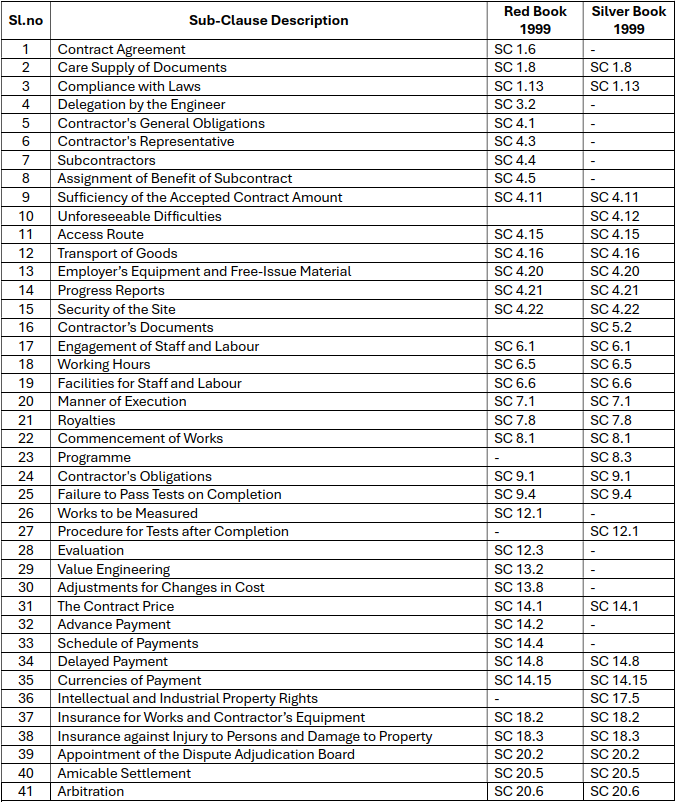
Based on the above terms, I was able to identify about 36 & 29 Sub-Clauses in GCs in Red Book & Silver Book respectively, with such provisions to make amendments as long as the risk balance and the intended purpose of the Sub-Clauses are not altered. The below table shows the provisions in Red Book & Silver Book, 1999 Edition.
6. Excerpts of the sub-clauses in GCs with provisions of amendments
The above Sub-Clause 8.1, Commencement of Works is an example of how FIDIC alIows the users to reasonably amend the commencement date. If both parties mutually agree to reduce this time from 42 days to 30days, this change is still considered a fair amendment and the contract is still a valid FIDIC contract.
7. The Counter
With the understanding of how the intent behind the amendment determines the validity of such changes, it is necessary to understand the reasons for the sample amendments to derive our conclusion.
Reason for Amendment #1 : To include an Interpreter
The contractor under this contract was a chinese firm and the employer had worked with this contractor in the past. The intention of the Employer behind this amendment to include a interpreter/translator was to ensure clear communication between the parties, as the employer has faced difficulties in the past.
Reason for Amendment #2 : To reduce Monthly Progress Report copies from 6 to 1
The Employer under this contract was a state organization and had realistic commitment towards sustainability and endorsed internal policies to reduce paper usage as part of a larger initiative under the Government regulations. This regulatory strategy and the presence of good digital document management in place ruled out the necessity of six copies of monthly progress reports.
Reason for Amendment #3 : To add new Sub-Clause on Alcohol
The country of the project to be executed was based on sharia principles and under the governing law of the country, it was mandated that every contract involving international parties shall include the clause on Alcohol, Liquor & Drugs. As FIDIC General Conditions of contract do not explicitly specify this, it was only reasonable to include this as a new sub-clause. This was to ensure the contract was in compliance with the local law and regulations.
8. The Conclusion
As these above amendments to the General Condition were made with good reason & intentions, to avoid disputes & to ensure compliance with law is clearly in line with the golden principle of FIDIC. It can be concluded that such changes or amendments to the General Conditions of Contract made in line with FIDIC Golden Principles and which do not alter the risk allocation DO NOT make the contract a bespoke and such a contract is still a FIDIC Based Contract.
With this it is evident that, sometimes making reasonable changes to the GCs are equally important as not making unfair changes to ensue that the overall essence of FIDIC forms of contract remains intact.
A contract only truly becomes "Bespoke" when the core risk-sharing mechanism, lets call it the "soul" of the FIDIC form is unilaterally discarded. Amendments made with good reason, which do not alter the fair allocation of risk and which stay in line with the Golden Principles, do not change the nature of the contract. Recognizing the difference between a "tailored" FIDIC contract and a "bespoke" one is essential for maintaining the overall essence and integrity of international construction standards.
9. Learning Outcomes
Understanding the FIDIC Golden Principles is of great significance in ensuring proper contract drafting.
Copying a standard form of contract without amendments can be more dangerous than making reasonable changes.
FIDIC contracts allow for flexibility, provided that modifications remain within the framework of the Golden Principles.
References:
FIDIC Conditions of Contract for EPC/Turnkey Projects, 1999 Edition (Silver Book)
FIDIC Conditions of Contract for Construction, 1999 Edition. (Red Book)
The FIDIC Golden Principles, First Edition 2019 https://fidic.org/books/fidic-golden-principles-2019